Lebanon and Israel Sign Preliminary 14-Point Agreement Amid Hezbollah Opposition
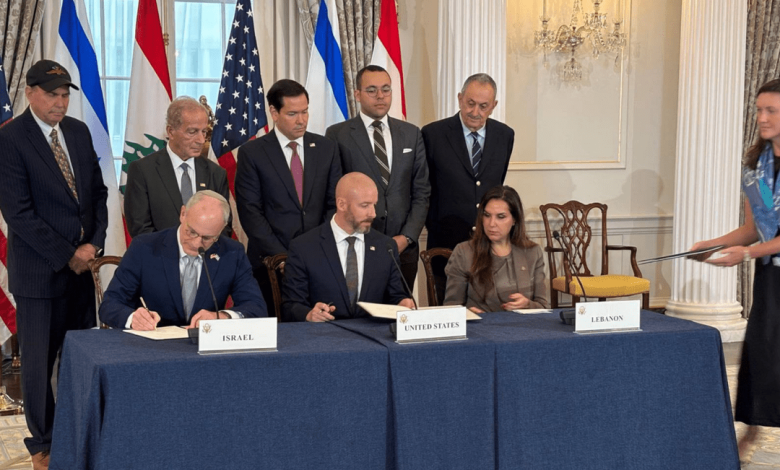
Israeli media have reported that Lebanon and Israel, following several rounds of negotiations in Washington, have signed a preliminary 14-point agreement accompanied by a confidential security annex. The agreement comes amid strong opposition from Hezbollah and rising concerns over escalating military tensions along the northern borders.
On Sunday, the newspaper Yedioth Ahronoth wrote that the agreement comprises 14 points and a confidential security annex but did not provide details about the annex’s content. According to the newspaper, Israel has expressed hope that the deal could lead to some form of peace with the Lebanese government.
The agreement was signed late Friday evening after four days of negotiations in Washington mediated by the United States and following the fifth round of talks between the two parties. The deal is preliminary and broadly outlined.
In contrast, Hassan Fadlallah, Hezbollah’s representative in the Lebanese parliament, described the agreement as “illegitimate and unlawful,” stressing that Hezbollah would mobilize all its capabilities to prevent its implementation. He stated that direct negotiations with Israel violate Article 52 of the Lebanese Constitution and that no individual or institution has the authority to cancel the state of hostility toward Israel.
Meanwhile, a senior Israeli official declared that “the Israel Defense Forces will maintain full operational freedom throughout the security zone to counter any threats.” The newspaper reported that, due to concerns over potential Hezbollah attempts to disrupt the agreement process, the Israeli military is preparing for increased tensions in the north.
The report further cited an Israeli security source who claimed that Hezbollah might target the Lebanese army forces to obstruct the agreement’s implementation. However, some observers view this claim as part of psychological warfare and pressure tactics.
This source also alleged that the United States would not restrict Israel’s military freedom of action in Lebanon and that any Israeli moves in the Dahieh area of Beirut could trigger a response from Iran.
On the other hand, Yair Golan, head of Israel’s Democratic Party, expressed doubt about the agreement’s feasibility, saying the document is largely symbolic and that Lebanon’s government would face serious challenges in meeting its conditions. He characterized the process as part of Israeli Prime Minister Benjamin Netanyahu’s controversial policies.
These developments occur against a backdrop of decades of hostile relations between Lebanon and Israel. Any potential agreement between the two could have wide-ranging political and security implications within Lebanon and across the region.