Taliban Bans Smartphones in Offices; Employees Report Workflow Delays and Threats of Dismissal
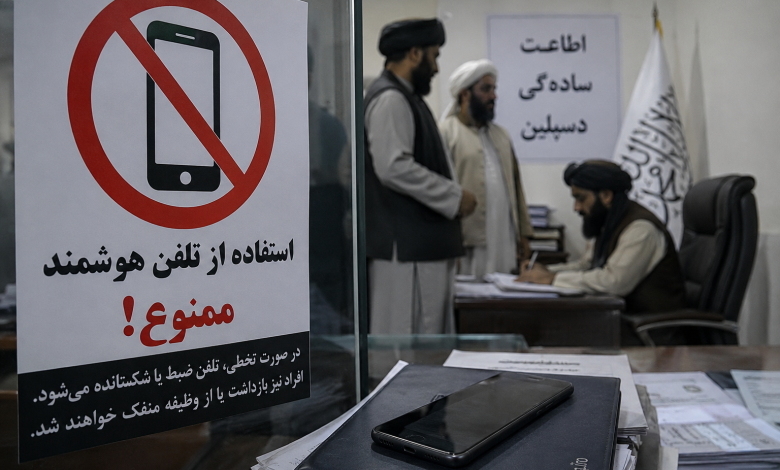
The Taliban have widely implemented a ban on the use of smartphones in institutions under their control, with employees reporting that the decision has seriously disrupted administrative processes. According to them, warnings have been issued that in case of defiance, phones will be confiscated or destroyed, and individuals will be detained or dismissed from their duties.
This directive has now been enforced in the majority of offices. The Ministry of Commerce and Industry recently informed employees from grades eight to three that they are not allowed to use smartphones in their offices and will face dismissal if they violate this rule.
An employee of this ministry, who wished to remain anonymous, said the decision has had a direct negative impact on morale and daily work. According to them, most official correspondence and urgent coordination were previously conducted through messaging apps, but now handling matters has become slow and difficult. They added, “We have practically returned to the pre-phone era, and it is unclear where this situation will lead the offices.”
In recent days, reports have also emerged from provinces stating that smartphones belonging to several employees have been collected and even smashed. Sources say this order was issued verbally by Hibatullah Akhundzada, the Taliban leader, and dozens of devices have been confiscated or destroyed as a result.
The consequences of this decision are not limited to government offices. Some shopkeepers in Kabul confirm that smartphone sales have declined, and many residents, fearing the ban might spread to the general public, are refraining from purchasing new phones. According to them, the stagnation in the mobile phone market has directly harmed the business of sellers.
Simultaneously, the Taliban administration has also prohibited the use of smartphones for university professors, employees, and students. Earlier, the University of Kabul declared that possessing a smartphone was “strictly forbidden” for students.
This restriction is imposed despite smartphones being essential tools for education and research. The United Nations Educational, Scientific and Cultural Organization (UNESCO) defines mobile learning as the use of devices such as smartphones and tablets to access educational content; a method that enables learning anytime and anywhere.
Some human rights activists and media workers warn that the expansion of this ban could seriously limit access to information, online education, and the documentation of human rights violations and administrative corruption. They believe that continuing this approach will not only weaken the efficiency of offices but will also further damage transparency and the free flow of information—a matter that, given the current situation in Afghanistan, will have extensive social and educational repercussions.