Battle of Alliances: From the Strait of Hormuz to Iran’s Eastern Borders
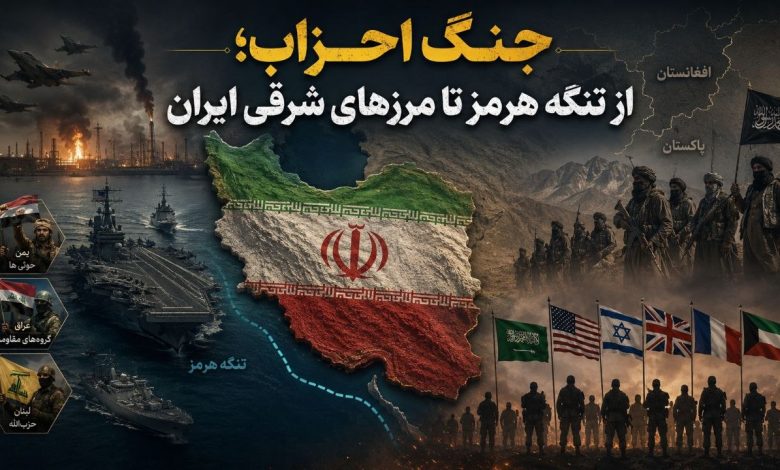
Several days have passed since the renewed round of hostilities between Iran and the United States began, with both sides gradually targeting each other’s infrastructure.
The US is attempting to regain control over the Strait of Hormuz by re-imposing a maritime blockade and attacking Iran’s infrastructure, aiming to prevent an energy crisis and economic recession in Western countries.
In response, Iran has maintained its dominance over the Strait and countered American attacks with reciprocal measures.
Some military analysts believe the US may escalate to ground operations and even attempt to capture Khark Island to shift the balance of the conflict.
It is clear that Iran has long prepared for such a scenario and would seek to inflict significant casualties on invading forces if the US initiates a ground war.
Furthermore, if the conflict reaches this stage, Iran’s regional allies are expected to become involved. Yemen’s Houthis, various Iraqi groups, and Lebanon’s Hezbollah each possess the capability to threaten US interests within their respective territories.
Meanwhile, available evidence suggests that the US wishes to transfer much of the human cost of any potential ground operation to regional Arab countries.
Some Arab states, including Saudi Arabia and Kuwait, have effectively aligned themselves fully with the US front. These countries have not only cooperated with the US but have also conducted direct attacks against Iran, while Saudi Arabia has simultaneously targeted Yemen.
Analysis of existing data also indicates that some European countries, although refraining from direct involvement in the war, have increased their logistical and operational support for US actions. They consider it crucial that the Strait of Hormuz not remain under Iranian control.
Put simply, another coalition war appears to be taking shape; a conflict in which the US seeks to use all its capacities and allies to control the Strait of Hormuz.
Regardless of the fact that the strategic importance of the Strait for the global economy and the US is more apparent than ever, should the war expand, each of Washington’s allies will likely be assigned specific missions.
For example, Saudi Arabia may be tasked with containing the Yemen front to prevent Ansarullah’s supportive actions on behalf of Iran.
It is also conceivable that Ahmed Al-Shara and his forces in Syria could be assigned to increase pressure on Hezbollah in Lebanon to engage the group and reduce the human and military burden on Israel.
However, the key question remains: if the US decides to conduct a ground invasion of Khark or any other part of Iran’s geography, considering the preparedness of Iran’s military forces, what strategies does it have to minimize its own casualties?
Some assessments indicate that instead of relying on its own combat troops, the US might employ multinational mercenaries, predominantly Arab, to reduce the political and social costs of American military deaths.
In this context, the role of Iran’s eastern neighbors, especially Afghanistan and Pakistan, will become increasingly important. There is a possibility that separatist and terrorist groups supported by the US could simultaneously become active in the east to create insecurity on Iran’s borders as hostilities intensify.
Under such conditions, it is clear that Iran cannot base the security of its eastern borders on statements from the Pakistani government nor place trust in the Taliban’s Salafi administration.
If Iran requires popular-based allies in Yemen, Iraq, and Lebanon to secure strategic depth along its western borders, it will need a similar grassroots support structure to maintain security along its eastern frontiers.
By Seyed Ahmad Mousavi Malagh