Sharp Decline of Traditional Sesame Oil Factories in Ghazni Threatens Local Economy
In Ghazni province, the number of traditional sesame oil extraction factories, once nearly 200, has dropped to fewer than seven this year. This decline is attributed to the introduction of new machinery for oil production, which has marginalized traditional methods.
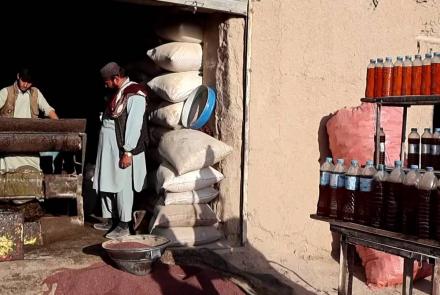
Nonetheless, some traditional producers, who have typically inherited their craft through generations, continue to operate despite challenging conditions. One such producer, working in a small room, processes sesame seeds using animals and wooden devices, producing both oil and cake.
Although the traditional method is time-consuming and labor-intensive, this producer claims that his products still attract a specific customer base due to their natural qualities and sell at higher prices. Meanwhile, modern factories produce sesame oil on a larger scale and with higher capacity.
According to statistics from the Ghazni Directorate of Agriculture, Irrigation, and Livestock, about 650 jeribs (approximately 137 hectares) of land have been allocated to sesame cultivation this year, yielding roughly 500 metric tons of sesame—a 15% increase compared to last year.
Despite the growth in sesame production and the expansion of modern factories, the significant decline of traditional sesame oil extraction factories poses a serious threat to the local economy and the livelihoods of families in Arzu village, who still rely on these traditional production methods.