Cambridge meeting calls for opposition unity and equal rights in Afghanistan
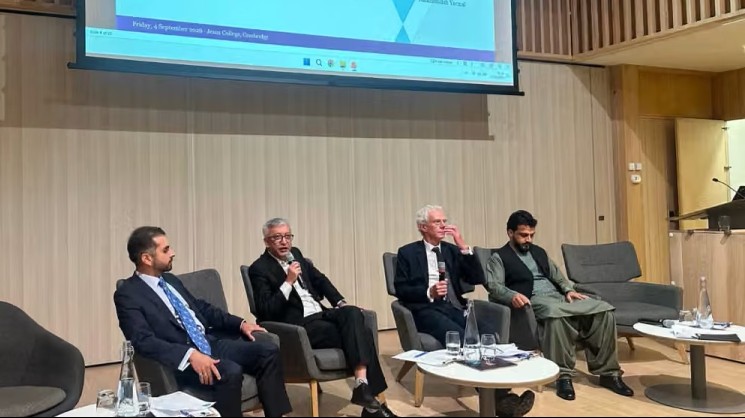
The fifth Cambridge Afghanistan meeting was held on September 4 and 5 at Jesus College, University of Cambridge. The gathering focused on bringing political, civil and anti-Taliban groups closer together in order to reach a common framework on Afghanistan’s political future. Participants stressed the need for political change, a democratic structure and the protection of equal rights for citizens.
Ali Maisam Nazary, head of foreign relations for the National Resistance Front of Afghanistan, said there is broad convergence among the groups opposing the Taliban administration on fundamental principles. He added that despite differences of opinion, these groups agree on the need for political change and the guarantee of equal rights for citizens.
According to him, disagreements among opponents reflect Afghanistan’s ethnic, religious and political diversity and should not stand in the way of joint cooperation. Nazary stressed that political unity does not mean making views identical, but can be built on accepting differences.
Based on data from the Global Mosaic Foundation, a review of more than 20 political road maps shows that about 90% of the views raised in areas such as political participation, fundamental rights and citizen equality overlap. The remaining differences are said to relate mainly to the method of political change, the role of the international community, the centralized or decentralized structure of any future system, national identity and symbols, and addressing historical injustices.
Zalmai Nashat of the Global Mosaic Foundation said the goal of the meeting is not to resolve disagreements immediately, but to create a setting for dialogue and identify points of agreement and difference. He described the “Political Convergence Framework” as a mechanism to bring political groups, civil society, women, resistance forces and human rights institutions together in a shared structure.
Daud Nazi, head of the political office of the Afghanistan Freedom Front, also said the front is ready to cooperate with political parties, civil institutions, women and democratic movements. He added that differences over the structure of a future system are natural, but the final decision should be left to the people of Afghanistan.
Hussein Eshraq said at the opening of the meeting that a transfer of power without reforming the style of governance would not lead to lasting peace. He described the Cambridge Consensus framework as a document that links political legitimacy, social cohesion and development.
Zalmai Nashat also pointed to the suppression and systematic deprivation of women, saying Afghanistan is not in a peaceful situation. According to him, peace means not only the absence of war, but living without fear and having access to basic rights — an issue made more acute under Taliban rule, with widespread restrictions, especially for women.
Sir Laurie Bristow, a former British diplomat, said the international community must honestly examine the mistakes of the past 20 years in Afghanistan. He stressed that no lasting agreement can be imposed on Afghanistan from outside and that the people of Afghanistan must themselves lead decision-making about the country’s future.
Bristow also stressed the need for an immediate response to the humanitarian situation, an end to the exclusion of girls from secondary education, and a solution for Afghans living in Pakistan and Iran who face the risk of forced return. Banafsha Yaqoubi also said that Afghan women’s experiences of repression are not the same, and that political and human rights processes should pay greater attention to rural women, urban women, women with disabilities and low-income families.
Under the announced plan, the organizers intend to turn the CCF framework from a theoretical document into a practical process for coordinating opponents of the Taliban administration. The creation of an advisory council, specialized talks and the participation of human rights institutions are among the mechanisms envisaged in the plan, and its founding charter and working group are due to take shape in October 2026.
The Cambridge Afghanistan meeting is among the events held outside the country with the participation of political, civil and human rights figures on Afghanistan’s future. The University of Cambridge in Britain hosted this round of talks.