Afghan Ex-President’s Chief of Staff Calls Rubio Speech in Greece a ‘Call for Civilisational War’
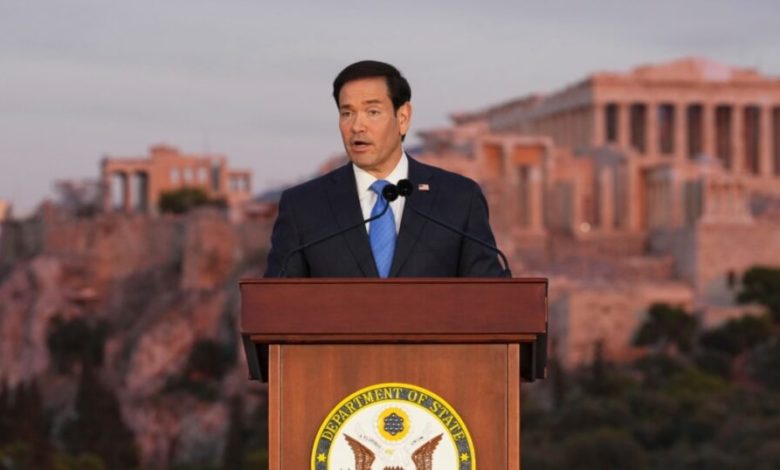
Abdul Karim Khurram, chief of staff to Afghanistan’s former president, has criticised US Secretary of State Marco Rubio’s remarks in Greece, saying in a new note that the speech was “radical” and “civilisational” and was calling on Europe to prepare for a “civilisational war.”
Khurram wrote that he had intended to write about regional developments and the situation in Afghanistan, but that Rubio’s statement had fully captured his attention. According to him, Rubio delivered his speech last Wednesday atop the historic Acropolis hill and in front of the Parthenon temple — remarks Khurram believes “should have come out of the mouth of someone like Samuel Huntington, not a secretary of state.”
In Khurram’s view, Rubio described Western civilisation as the “pillar of the world” and the United States as the “pillar of the West,” and this outlook was a continuation of his comments at the Munich Security Conference, though this time, Khurram said, it was presented “more intensely and more radically.”
Khurram also wrote that although Rubio’s reference to the “Persian Empire’s attack,” made at a time of tensions between Washington and Tehran, drew some public attention toward Iran, the central message of the speech goes beyond Iran and could be interpreted as “a call for Europe and countries that see themselves as heirs to Greek and Roman civilisation to prepare for a civilisational war.”
He described this kind of rhetoric as the behaviour of declining powers and, pointing to the collapse of the Soviet Union, said that on the eve of its downfall, “the theory of Marxism-Leninism had become ineffective and its followers made nationalism their new refuge.” Khurram added that in Afghanistan too, “defeated Marxists took refuge in ethnic nationalism and were the ones who started the disaster and civil war.”
In another part of his note, Khurram described Washington’s current policy as an attempt to mobilise the West against the East, writing: “America, seeing itself in confrontation with China, Russia, Iran and Easterners in general, and finding success in that difficult, wants to pull part of the world to its side by stirring Western civilisational sentiments.”
According to him, this outlook is among the intellectual foundations of Donald Trump, his vice president and the US secretary of state. Khurram said this current believes Western weakness stems from being cut off from its own “roots, culture and history,” and compared it with some Islamic currents that prescribe a “return to the predecessors” as the solution.
Meanwhile, based on parts of the speech reflected in Khurram’s note, Rubio described the West as being at a “civilisational turning point” and urged Europe to “wake from its long sleep and rekindle the civilisational fire of the past.” Referring to the role of ancient Greece in shaping Western civilisation, he said, “America’s history is covered with the fingerprints of ancient Greece,” and warned that the West must choose between “civilisational renewal or handing the next century to its rivals.”
Rubio also recalled Xerxes’ attack on Athens, describing it as an example of “civilisational resistance,” and said the West today also faces threats that, he claimed, are “just as real and serious.” In another part of his remarks, he described “extreme individuality, relentless ambition and a desire for discovery and risk” as traits of Western civilisation, and claimed these traits have “eroded” in the modern era.
The Acropolis and the Parthenon are among the best-known symbols of ancient Greece, and speeches by political figures at these sites usually carry historical and cultural symbolism — a factor that in this case also shaped Abdul Karim Khurram’s reading and criticism of the US secretary of state’s political message.