Badakhshan: Pakistan’s Game with Taliban Fault Lines
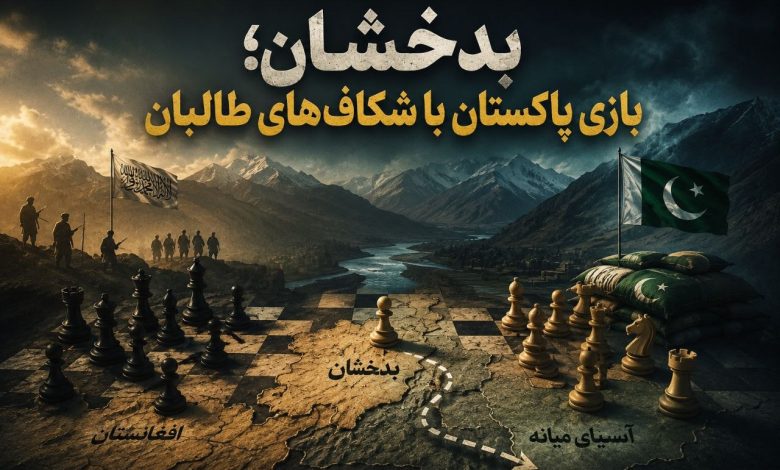
The current clashes in Badakhshan cannot be described as a “war against the Taliban.” What is unfolding in the region today, at this stage, looks more like an internal factional conflict than a social uprising against Taliban rule.
There are at least two reasons for this assessment.
First, according to his own account, Jumma Khan Fateh still considers himself a Taliban member despite his clashes with Taliban forces, and has not stepped outside the group’s ideological or organisational framework. Second, the nature of the conflict remains confined to intra-Taliban rivalries, and the people do not play a decisive role as an independent force opposing the Taliban.
But the main question is whether this war is merely an internal dispute, or the prelude to a larger transformation in the region.
A number of indications strengthen the possibility that destabilising northern Afghanistan could be part of a regional project in which Pakistan has a role in designing, directing and exploiting it.
If we accept such a premise, Pakistan’s aim in supporting these clashes is not necessarily to strike the Taliban or weaken the group, but could involve other objectives behind the scenes.
The Taliban’s treatment of Jumma Khan Fateh is among the indications supporting the above hypothesis. Until a few days ago, Fateh was in Kabul and in Taliban custody. If the Taliban had considered him a real and dangerous enemy, they could have removed him from the scene — as was done with Mawlawi Mehdi — but that did not happen. Fateh simply returned to Badakhshan, took command of thousands of armed men, and began fighting his former comrades.
This reality raises a serious question: does the Taliban regard Fateh as a “rebel” commander who must be punished, or is he part of a larger plan that, knowingly or unknowingly, is being used for purposes beyond this group’s internal disputes?
If this conflict is merely a disagreement between a disgruntled commander and the Taliban leadership, its consequences would naturally remain limited to Afghanistan; but if insecurity crosses Afghanistan’s borders and spreads to Central Asia, the nature of the issue will change completely. In that case, Badakhshan could become a point of connection between insecurity in Afghanistan and Central Asia.
Over the past several decades, Pakistan has acted as an implementer of US policy in regional security developments. Therefore, if a US project is taking shape to transfer insecurity from Afghanistan to Central Asia, Islamabad would be the best option to carry it out.
If the Russia-Ukraine war and the conflict between Iran and the US and Israel are examined from the perspective of strategic pressure on Washington, then in a situation where the US appears to be facing serious pressure on both fronts, it is natural that Washington would seek to create new fronts to pressure Russia and Iran, and Central Asia could be one of the potential areas for a new conflict.
The aim of such a project would not necessarily be to occupy territory or establish a new government in Central Asia. It would be enough for insecurity to take hold in the region and spread to areas that Russia considers part of its security sphere, so that the country faces a serious and costly security challenge in containing Salafi armed groups, extremist networks and instability on its southern borders.
But Pakistan faces a serious limitation in using Pashtun forces to implement such a project.
Islamabad itself is dealing with Tehreek-e-Taliban Pakistan and deep grievances in Pashtun-populated areas, and a large-scale deployment of Pashtun fighters into a cross-border project and their transfer to Central Asia could have unpredictable domestic consequences for Pakistan.
For this reason, using non-Pashtun Salafi forces may be a better option for Islamabad — forces that can move towards Central Asia without Pakistan becoming directly entangled in the Pashtun ethnic issue.
It is in such circumstances that Badakhshan and the non-Pashtun fighters of these areas gain particular importance, and support from figures such as Abdul Hamid Khorasani for Fateh also becomes significant within this framework.
Jumma Khan Fateh may initially be only a disgruntled Taliban commander, but if his war becomes a platform for recruiting fighters, activating other dissatisfied commanders and creating an armed network of foreign fighters in northern Afghanistan, then the issue will no longer be merely a dispute between Fateh and the Taliban.
If, in the coming days, the Taliban limit themselves to managing the clashes and refrain from forcefully suppressing their opponents, the question will become more serious: is the Taliban, consciously, playing a role in the project of transferring insecurity to Central Asia, in coordination with Islamabad and Washington?
Seyed Ahmad Mousavi, the propagandist