Taliban Enacts Law to Document War Narratives and Suicide Attacks
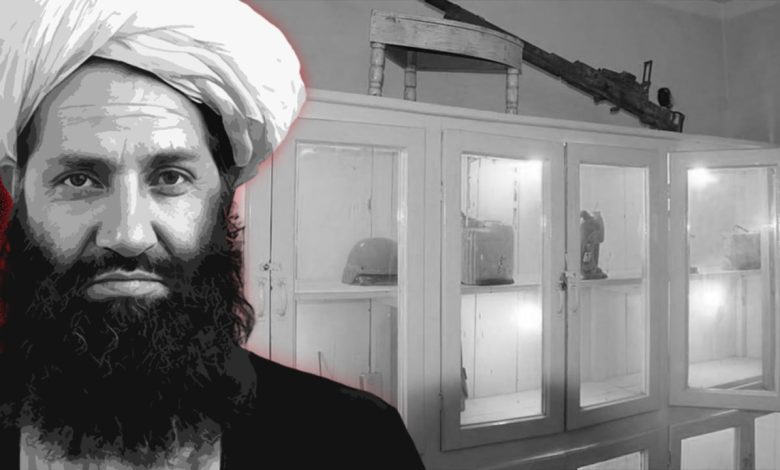
Hibatullah Akhundzada, the leader of the Taliban administration, has enacted the “Law on Preservation of Jihadi Artifacts,” a document mandating the group’s Ministry of Information and Culture to record the narratives of suicide attacks, the 20-year war, and the military equipment used by the Taliban, and to display them in museums. This law was publicized today (Monday, June 8) by the Taliban’s Ministry of Justice.
The document is composed of two chapters and 14 articles, requiring all civilian and military institutions of the Taliban administration to collect, record, and publish written and audio accounts related to the group’s war against NATO forces and the previous republic. According to Article 3, a new institution named “General Directorate for the Preservation of Jihadi Artifacts” has been established within the Ministry of Information and Culture.
Article 7 assigns this directorate the responsibility for registering the tangible and intangible artifacts of the Taliban’s war from 2001 to 2021, as well as the history of the formation of the “Islamic Movement of the Taliban.” This article also emphasizes the documentation of what it terms “the crimes and oppressions of the enemy.”
In Clause 2 of Article 8, the registration and documentation of suicide attacks and related events are explicitly mandated. The directorate is also tasked with collecting what it defines as the “ethical, cultural, ideological, and political deviations,” as well as the “ethnic, sectarian, and linguistic biases” of the previous republic.
According to Article 9, tanks, helicopters, artillery, and other equipment remaining from the war must be exhibited in museums as specimens. Even if the original items are unavailable, creating replicas for display is required. Detailed recording of light and heavy weapons, mines, homemade barrels, missiles, traps, and remote controls is also listed among the directorate’s responsibilities.
Beyond physical artifacts, the law calls for the registration of “intangible artifacts,” including stories, memories, poems, songs, and oral accounts related to the Taliban’s martyred Mujahideen. However, Article 12 specifies that the directorate cannot record or publish images of the human soul and that all documentation must be in text and audio form.
Over the past nearly five years, the Taliban administration has held exhibitions titled “Jihadi Artifacts” in museums and cultural directorates in Kabul, Kandahar, Kapisa, and several other provinces. These exhibitions have displayed suicide vests, homemade yellow barrels, and magnetic mines used in roadside attacks and targeted assassinations—actions seen by many observers as normalizing and promoting tools of violence in a war-torn society.
Experts believe the official focus on documenting and displaying suicide attacks and explosive devices, rather than addressing civilian casualties and the human consequences of war, could pose new challenges to national reconciliation and social reconstruction—an issue that the Taliban administration has yet to clearly address.