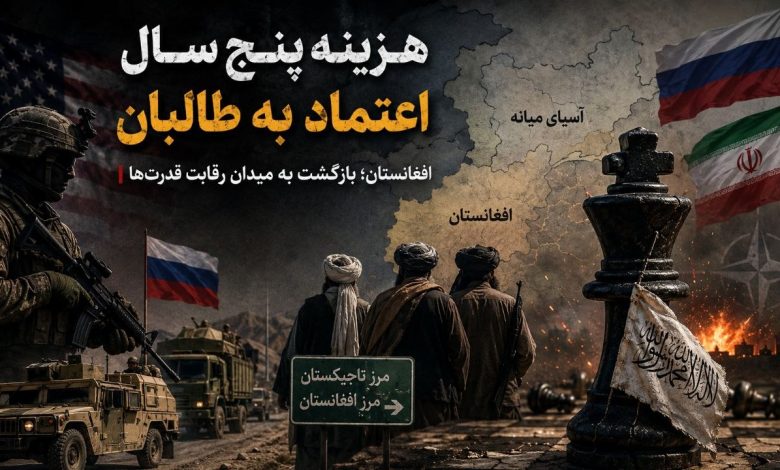
Five Years of Trust in the Taliban Comes at a Cost
Badakhshan’s Zebak district is the scene of widespread clashes, while scattered attacks against the Taliban are also taking place in various cities. Mehterlam and Herat witnessed two explosions last night, in which Taliban forces are said to have been targeted.
Meanwhile, Russian sources have said the country is sending weapons and equipment to the Afghanistan-Tajikistan border to prevent insecurity from spreading into Central Asia.
During the unrest surrounding Friday Khan Fateh in Badakhshan, I wrote in a note that the United States may be interested in compensating for NATO’s defeat in Ukraine by creating pressure and insecurity in Central Asia, and that the prerequisite for such a development is increased insecurity in Afghanistan so that the countries of the region are also drawn in.
It is also said that during the CIA chief’s visit to Russia, the United States asked Russia to stop cooperating with Iran; however, this request did not receive a positive response.
The United States is engaged on two fronts: in Ukraine, against Russia, and in a direct war with the Islamic Republic of Iran. At a time when Washington is facing difficulties and setbacks on both fronts, it would not be unlikely for it to try to challenge its rivals with a single formula in another environment.
In such circumstances, if the Russians have concluded that they must secure the southern borders of Central Asia by deploying equipment and forces and take a more cautious approach toward Taliban-ruled Afghanistan, it is unlikely that Iran will remain indifferent to these developments. The changes seen in Iran’s policy toward the Taliban, from inviting the leaders of the Resistance Front to the funeral ceremony of the martyred leader to their presence and invitation to the Islamic Unity Conference, which is now underway, may be a sign of this reassessment.
Distrust of the Taliban and the possibility of the implementation of US anti-security plans against the countries of the region from Afghanistan’s geography, as well as the Taliban’s destructive role in this project, were not things that Afghanistan affairs specialists had not spoken about over the past five years.
Russia and Iran’s cooperation with the Taliban during these years destroyed many capacities that could have acted to alter the balance of power tools in Afghanistan in favor of the countries of the region.
An insecure Afghanistan is to the detriment of the region and to the benefit of the United States, and in essence, the handover of Afghanistan to the Taliban by the United States was an effort to preserve the capacity for crisis-making, not to secure safety and stability.
Russia and Iran have been caught up for all five years in the Taliban’s soft intelligence game. Perhaps the most important mistake in the regional countries’ policy toward the Taliban has been that they accepted the Taliban administration as an instrument of stability, while at the same time destroying and sacrificing all the security-building and stability-producing capacities in Afghanistan that were necessary to create a balance against the Taliban in fruitless engagement with the group.
Now, if Afghanistan’s neighbours are forced to make up for lost ground, they will have to pay a heavy price for what they themselves have destroyed. In the current situation, if the Taliban — in alignment with US plans — no longer wants to play the role that Russia and Iran expected of it in ensuring stability, the issue is no longer merely finding a replacement for the Taliban as an ally; the issue is that many of the tools that could have been used to contain the Afghanistan crisis have disappeared over these five years.
If regional countries are seeking to reduce their own security vulnerabilities stemming from Afghanistan’s geography, before taking any action they must remove the pro-Taliban current within their decision-making institutions regarding Afghanistan from Afghan affairs.
The continuation of this current, which is aligned with and supportive of the Taliban, will help increase instability in the region.
The first step in securing regional stability for Iran and Russia is to remove people such as Hassan Mortazavi and Zamir Kabulov from the Afghanistan file.
Seyed Ahmad Mousavi Moghadam