Taliban’s Persian Language Policy Under Scrutiny Despite Claims of Change
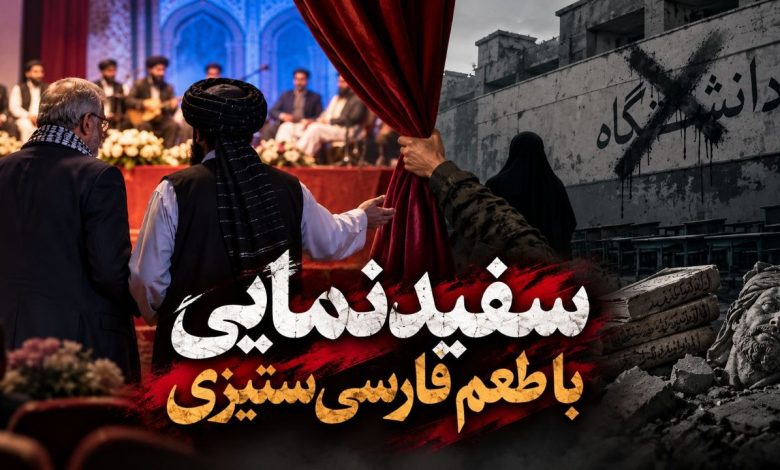
Khorasan newspaper, in its issue dated October 26, published an interview with Dr. Mohammad Jafar Yahaghi, a prominent professor of Persian language and literature and director of Ferdowsi Cultural Center, discussing the Taliban’s changing approach towards the Persian language.
The interview followed a trip in October when a group of Iranian poets and professors visited Afghanistan, during which joint literary events, including the poetry night “From Hariva to Nishapur” in Herat, were held in collaboration with cultural institutions managed by the Taliban.
Mr. Yahaghi, a well-known figure and authority in the Persian language field, claimed in the interview that the Taliban have gradually recognized the necessity of using Persian. He cited the organization of poetry gatherings and the respectful treatment of Iranian poets and professors by the Taliban as indicators of this shift.
However, the crucial question remains: Has the Taliban’s anti-Persian policy genuinely changed? Or are Mr. Yahaghi’s observations merely part of a cultural showcase staged by the Taliban for Iranian guests?
Over more than five years of their renewed rule over Afghanistan, the Taliban have repeatedly taken measures to limit the status of the Persian language.
These include removing Persian words from official correspondence and signage, attempting to replace Persian terms in universities and government bodies, and changing historical place names—actions well-documented during this period.
Additionally, the Taliban have banned the import of Iranian-printed books into Afghanistan, confiscated Iranian publications from libraries, restricted Afghan publishers’ participation in the Tehran Book Fair, among many other anti-Persian measures.
Given this context, how can a respected professor conclude, based on a handful of poetry events and courteous receptions by Herat’s literary association officials, that the Taliban are reconsidering their language policies?
Interestingly, in the same interview, Mr. Yahaghi speaks at length about the roles of British and Russian colonialism in undermining the historical status of Persian, yet when addressing contemporary Afghanistan, he relies on ceremonial observations from his trip rather than critically examining the Taliban’s current policies.
Cultural ties among Persian speakers in Afghanistan and Iran are undeniably important—but only if such exchanges support the Persian language rather than serve to whitewash the Taliban.
If the Taliban have truly revised their policies, why is this change not clearly and consistently reflected in the position of Persian language in Afghan universities, official correspondence, signage, and cultural institutions?
Considering Mr. Yahaghi’s academic standing and extensive research on Persian, one would expect him to verify the actual state of Persian in Afghanistan through direct dialogue with Afghan professors, writers, and cultural figures before endorsing such optimistic conclusions based on a staged visit, which is often exploited to improve the Taliban’s image for foreign guests.
Regrettably, this is not the first time popular Iranian figures, sometimes unwittingly, have aided those aiming to whitewash the Taliban’s image.
Previously, individuals such as the renowned eulogist Mohammad Hossein Pouyanfar and some Iranian documentarians became tools for sanitizing the Taliban through similar initiatives. Now, superficial impressions from a ceremonial visit by a respected professor are being used to legitimize the Taliban’s anti-Persian language policies.
Seyed Ahmad Mousavi, Cultural Promoter