Hamdullah Mohib Calls Taliban ‘War Orphans’ in New Book on Afghanistan’s Collapse
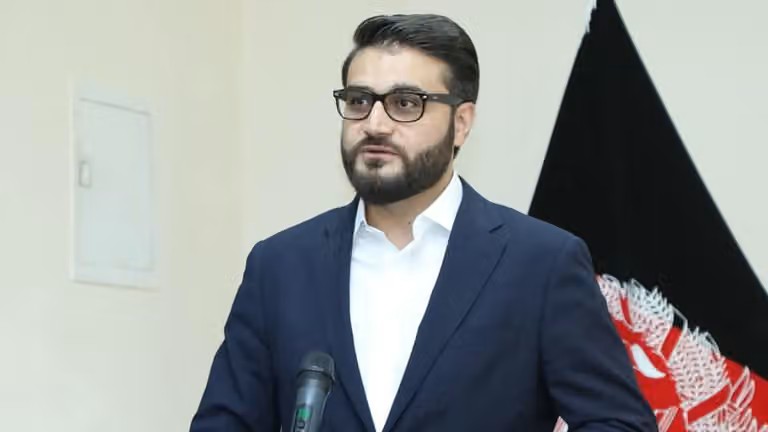
Hamdullah Mohib, Afghanistan’s former national security adviser, has described the Taliban as “war orphans” in a new book about the collapse of the previous government, saying the group grew up in Pakistani religious schools and became detached from Afghanistan’s diverse cultural and social heritage.
In Shadows Over Kabul, co-written with Tom Hussain, Mohib examines the Taliban’s ideological roots and the role of decades of war in shaping the group. In one passage, he writes: “The Taliban were war orphans raised in Pakistani madrasas, detached from Afghanistan’s rich and varied Islamic heritage.”
The former Afghan national security adviser argues that, contrary to its claim of representing Afghanistan’s traditions, the Taliban are a “wholly modern” phenomenon. He writes: “Then, in 1996, the Taliban arrived. The group saw itself as a guardian of tradition, but it was an entirely modern phenomenon. Its roots lay in Deobandism, a reformist movement that emerged in British-ruled India.”
Mohib also writes that decades of war severed the Taliban’s connection to Afghanistan’s religious traditions, including Sufism, and that the group’s understanding of religion is not a “received inheritance.” In the same section, he writes: “The Taliban’s Islam was not a received inheritance, but a fresh invention drawn from preservationist jurisprudence, the influence of Wahhabism and tribal conservatism.”
In his account, after coming to power, the Taliban imposed its vision of an “Islamic Emirate” on the country, a description Mohib says is close to “an idea of the historic Islamic caliphate.”
In chapter 12 of the book, titled “Running a Republic,” Mohib describes Afghanistan’s modern history as part of a broader struggle in the Islamic world over the relationship between religion and modernity, governance and identity. He writes that in the late 1970s, the then communist government regarded Islam as a relic of the past and referred to religious leaders as “Muslim Brothers”; several were arrested, tortured or killed.
He adds that in response to the repression of religious currents, Islamist groups emerged, some influenced by the ideas of the Muslim Brotherhood and largely known as political movements. Mohib then draws a distinction between the Taliban’s interpretation of Islam and earlier Islamist political movements.
In another section of the book, Mohib addresses the role of the United States in Afghanistan’s war, arguing that alongside military operations, Washington was engaged in a battle of narratives and ideology, and that, according to him, some senior US military commanders used religious concepts and terminology to advance their goals.
Shadows Over Kabul, with the subtitle “A Senior Official’s Account of the Fall of the Afghan Republic,” reviews the events that led to the collapse of the previous government and the Taliban’s return to power in August 2021. Hamdullah Mohib was one of Ashraf Ghani’s closest security officials and served as national security adviser until the fall of Kabul on August 15, 2021, leaving Afghanistan with Ghani. The role he and other senior republican officials played in the events leading to Kabul’s سقوط remains a subject of debate.