Taliban Leader Hibatullah Seeks Religious Legitimacy to Cement Political Power
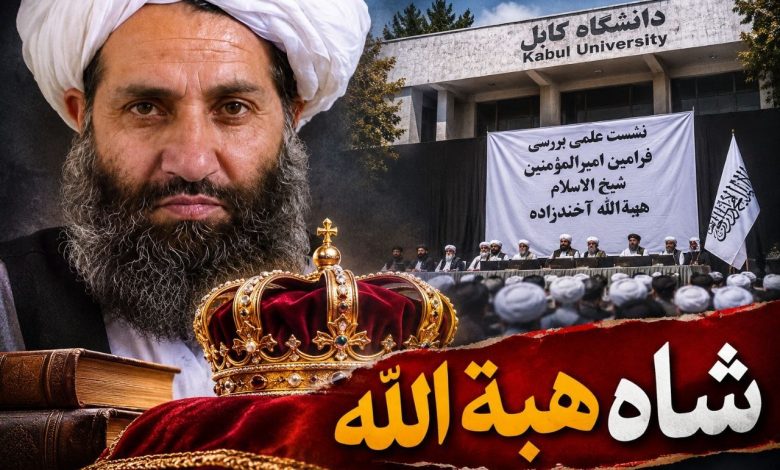
The Taliban leader has taken another step toward transforming his role from the head of a militant group to that of a sovereign, seeking to bolster his political authority with religious legitimacy.
One of the main objectives of the recent four-day meeting at Kabul University appears to be the effort to solidify the title “Sheikh al-Islam” for Hibatullah Akhundzada. The Taliban aim to use this title to elevate their leader’s position beyond political and organizational leadership to that of a religious authority recognized by the general public.
This shift could pave the way for political opposition to Hibatullah’s decisions to be viewed as defiance against religious authority, and political dissent could even be justified under the guise of religious duty.
The Kabul meeting pursued several key goals, including:
1. Establishing Religious Immunity for Political Power
Hibatullah has so far held the title “Amir al-Mu’minin” at the head of the Taliban structure, and his orders have been binding on group members. However, the push to confirm the title “Sheikh al-Islam” represents a step beyond organizational authority towards elevating him as a sovereign.
The Taliban seek to add claims of religious and scholarly authority to his political power so that his decisions are not merely government orders but are framed as religious decrees that cannot be challenged.
This approach effectively creates religious immunity for political power, transforming Mullah Hibatullah into “King Mullah Hibatullah,” where criticism of his decisions could be deemed opposition to religion.
2. Controlling Internal Divisions and Strengthening Individual Authority
Disputes between the Kandahar faction and some influential Taliban figures are an important reality within the group’s power structure.
By bringing together senior Taliban officials and religious scholars with differing views around Hibatullah’s directives, this effort attempts to redefine loyalty boundaries and raise the cost of dissent.
Hibatullah seems to strive to commit his internal opponents to absolute obedience without physically eliminating them, so that political and organizational opposition under the claimed religious authority would be perceived as disobedience to religious commands.
3. Leveraging University Prestige to Legitimize Royal Edicts
Kabul University, which ideally should be a place for knowledge production, critical thinking, and questioning authority, has now become a platform to endorse the Taliban leader’s orders.
The Taliban understand that to establish the position of King Mullah Hibatullah as a religious authority, they need not only approval from religious scholars but also social acceptance.
The leadership recognizes that controlling geography does not equal societal acceptance. The substantial social gap between the Taliban and the general public is a fact they cannot ignore.
Thus, using the prestige of Kabul University can be seen as an attempt to move beyond purely religious legitimacy towards achieving social acceptance. Hibatullah aims to challenge the social ties between the people and Taliban opponents and redefine this connection in his favor.
4. Producing Official Literature for Long-Term Stability of Royal Authority
The creation of hundreds of articles about Hibatullah’s decrees goes beyond simple propaganda. These works could become educational, research sources and foundations for justifying the Taliban’s governance policies in the future.
In other words, the Taliban seek to transform obedience to their leader from an organizational obligation into a principle embedded within the religious and political literature of their administration; thus, today’s individual edicts will be reproduced tomorrow as scientific and religious foundations for society’s governance.
5. Showcasing Kandahar’s Dominance in the Capital
Hibatullah’s presence in Kabul among senior government and academic officials sends a clear political message: despite the establishment of executive institutions in the capital, real decision-making power remains with the leader based in Kandahar.
By attending, Hibatullah demonstrates his superior control over the government structure and signifies that Kabul, as the administrative center, remains under Kandahar’s authority.
He also seeks to limit the possibility of an independent power balance against the Kandahar faction, a process that may most significantly affect the Haqqani network.
Overall, Hibatullah is trying to cement what the Taliban gained in negotiations with the US by securing religious legitimacy and academic credibility.
However, the fundamental question remains: can social legitimacy be created for a power that was established through agreements with the US and lacks the free consent of the people, only by bestowing religious titles and producing hundreds of articles?