Over 27,000 Families Displaced Amid Rising Tensions with Pakistan, Taliban Reports
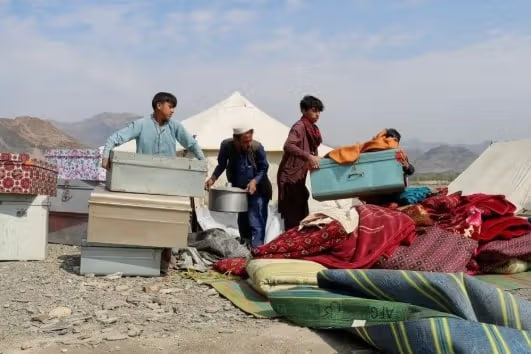
The Taliban administration has reported the displacement of 27,344 families following attacks by Pakistan across nine provinces, highlighting a growing wave of new displacements in eastern and southern Afghanistan. The Taliban’s Ministry of Economy, during a coordination meeting with United Nations representatives and domestic and international organizations in Kabul, announced that these families were displaced in Nuristan, Kunar, Nangarhar, Laghman, Paktia, Khost, Paktika, Zabul, and Kandahar provinces.
Din Mohammad Hanif, the Taliban’s Minister of Economy, appealed to international organizations at the meeting to provide immediate assistance to address the situation of the displaced families. The rise in displacement comes as many of these areas were already grappling with economic difficulties and limited basic services, with escalating insecurity further hindering people’s access to humanitarian aid.
Simultaneously, UN officials have warned that between 2 to 3 million refugees are expected to return to Afghanistan from Iran and Pakistan this year. According to UNICEF statistics, around 2.8 million people returned to the country last year.
Tajuddin Oyalay, UNICEF’s representative in Afghanistan, said at the meeting that addressing the needs of returnees is one of the main priorities of humanitarian agencies. He noted that last year, approximately 2 million people returned, including around 1.8 million from Iran and nearly 1 million from Pakistan.
Based on UN assessments, roughly 50 percent of returnees are children and 30 percent are women, including female-headed households — groups considered most vulnerable to economic and social hardships.
The UNICEF representative also stated that about 81,000 people have been affected by the recent tensions between the Taliban administration and Pakistan. He explained that clashes in districts such as Kamdish and Bargi Matal in Nuristan province have severely limited humanitarian assistance efforts, raising concerns about people’s access to basic services.
He urged donor countries and international organizations to increase their support to provide food and cash assistance to the displaced and returnees. He emphasized that services at border points like Islam Qala, Milak, Torkham, and Spin Boldak should continue from the moment migrants arrive until their stable resettlement.