Faceless Cities: The Taliban’s Gradual Erasure of Images from Afghan Urban Spaces
In many cities across Afghanistan, something is disappearing—not suddenly or loudly, but quietly and layer by layer.
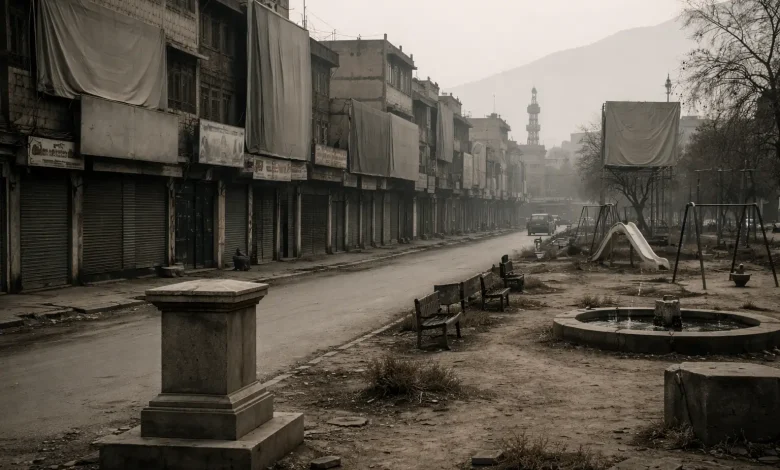
Faces are vanishing from shop signs, statues are no longer seen in squares, dolls lack faces, and parks are emptied of color and figures. What the Taliban call “religious reform” has in practice led to the gradual removal of representations of living beings from public spaces. This policy transforms not only the appearance of cities but also society’s relationship with images, bodies, and visual memory.
Ideological Roots: Image as Deviation
The Taliban’s ban on images and statues is neither new nor a temporary reaction. This approach is rooted in a strict interpretation of Sharia law that considers depicting living beings as akin to “imitating creation” and ultimately a form of idolatry.
Within this framework, images are not seen as artistic or cultural tools but as potentially dangerous; something that can be normalized, seen, and remembered. For this reason, since their first period of rule to today, the Taliban have consistently opposed statues, images, and human figures.
From Bamiyan to Present-Day Cities: Continuity of a Logic
The destruction of the Buddhas of Bamiyan in 2001 is often portrayed as an exceptional and historic act. However, the Taliban’s current policies show that event was part of an ongoing logic—one that today proceeds not with blasts but through gradual removal and so-called “reform.”
In recent months and years, urban statues across Afghanistan have been removed, covered, or disappeared without explanation. These removals often occur silently, without official announcements, public debate, or replacements.
This policy is not limited to prominent symbols. In some parks and recreational areas, toys depicting humans or animals have been either confiscated or faces covered. Swings, cartoon statues, and children’s decorative elements are gradually being eliminated.
The result is parks that still exist but are visually emptier; spaces intended to be joyful and child-focused have become neutral and faceless.
One of the most visible manifestations of this policy appears in markets and commercial streets. Signs of barbershops, clothing stores, beauty salons, and even some general shops that were once identified by images of women now either lack images or have faces completely covered.
In many cases, these changes are implemented not through written orders but via verbal pressure and local warnings. The result is a visual homogenization of streets and the removal of female bodies from public view.
A Public Space Without Images: How the City Is Transformed
Removing depictions of living beings is not merely an aesthetic change; this policy directly affects how people experience public spaces. When faces, figures, and human symbols are removed from squares, parks, and streets, the city gradually loses part of its visual language—a language that had represented history, identity, and everyday life.
In the absence of images, the visual diversity of cities decreases, and public spaces become neutral and indistinguishable. Squares look alike, parks lack narrative elements, and streets serve merely as passageways. This process weakens not only the historical and cultural memory of the city but also the connection between citizens and the spaces they inhabit.
In such an environment, people remain present but invisible. Bodies and faces are erased from the city’s visage, and seeing humans becomes a limited, private experience. The city is quietly emptied of human symbols—not because people are absent, but because seeing them is prohibited. This removal creates not silence but a visual void that itself becomes a form of meaning.
Conclusion
Today’s Afghanistan is witnessing a quiet yet profound transformation of public space, where images of living beings are progressively erased from the city’s face. Squares remain without statues, parks become faceless, shop signs lack images, and even simple children’s play elements fall under the shadow of prohibition. These removals are neither random nor isolated; they are part of a coherent policy to redefine what is “permissible” to see.
What disappears in this process is not merely statues or images. The real issue is the gradual erasure of human representation from shared life spaces: reducing the presence of bodies, faces, and memory within the city. A city where humans live but are less visible is a city whose meanings are not built but erased. Ultimately, this report is about that void—a void shaped in silence that transforms the city’s face without destroying it.
By Seyed Mostafa Mousavi