Kabul University Imposes New Pledge Enforcing Taliban’s Religious and Behavioral Codes on Students
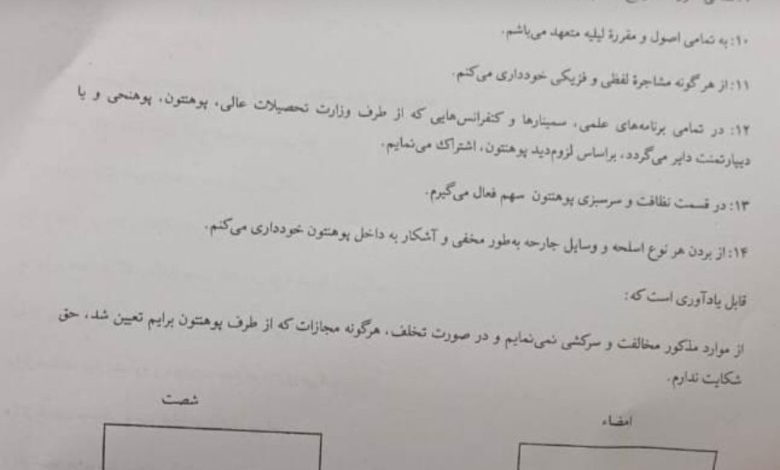
Kabul University, operating under Taliban administration, has required students to sign a written pledge obliging them to adhere to the standards set by the Taliban regime regarding worship, dress code, and obedience to the commands of the “Islamic Emirate.” The document stipulates that students must perform prayers in congregation, grow beards according to what is referred to as the “Prophetic tradition,” and avoid walking around campus without wearing a hat.
The pledge further emphasizes that wearing “Islamic Afghan clothing” is mandatory and that listening to music and playing musical instruments is strictly prohibited. Additionally, students are banned from photography and video recording, as the document states that capturing images of “living beings” contradicts Islamic law.
Signatories commit to fully abiding by all rules and commands issued by the Taliban administration, personally implementing the orders relevant to them. The text states that individuals consider the “Islamic Emirate” a religious system and deem obedience obligatory, declaring they have no affiliation with any political groups.
Another section of the document mentions that students do not have the right to oppose or disobey the specified terms. In case of violation, they forfeit any right to legal complaint against punishments imposed by the university. This condition has raised concerns about the curtailment of individual rights and academic freedom.
In recent years, the Taliban have exercised extensive control over universities nationwide, attempting to implement their interpretation of Islamic law within higher education. This approach has faced criticism from some professors and students, who view it as contradictory to academic independence and freedoms.
Following the Taliban’s return to power, a large number of university faculty members left the country. Subsequently, individuals close to the regime were appointed to various teaching positions—a development that experts say has negatively affected the quality of education in higher education institutions. Nevertheless, the Taliban’s Ministry of Higher Education continues to insist on full enforcement of what they call “Islamic Sharia” and the directives of Mullah Hibatullah Akhundzada.