Pakistani Anti-Terrorism Court Sentences Eight Journalists to Life Imprisonment
On Friday, an anti-terrorism court in Pakistan sentenced eight journalists and social media commentators to life imprisonment in absentia. The verdict was based on terrorism-related charges and online activities supporting Imran Khan, the country’s former imprisoned prime minister.
According to the court’s decision, these cases were filed following the violent protests on May 9, 2023, which erupted after Imran Khan’s brief detention. During these protests, several of his supporters attacked military installations. Subsequently, Pakistan’s governmental and military bodies launched a broad campaign against Imran Khan’s party and dissenting voices, using anti-terrorism laws to prosecute hundreds accused of incitement and attacks on state institutions.
The court stated in its ruling that the defendants’ actions fall within the scope of “terrorism” under Pakistani law and that the content they published online caused “fear and instability” in society.
Court documents reveal that most of the convicted individuals reside outside Pakistan and were not present during the judicial proceedings. Among them are Adil Raja and Syed Akbar Hussain, former Pakistani army officers now active on YouTube, as well as journalists Wajahat Saeed Khan, Saber Shakir, and Shaheen Sehbai, along with Haider Reza Mehdi and Moeed Pirzada.
Wajahat Saeed Khan, who lives in New York, responded to the verdict by stating that he had never received a summons nor was informed about the legal process. He described the ruling as a “political show” and emphasized that the sentence was issued without due legal process and fair trial procedures.
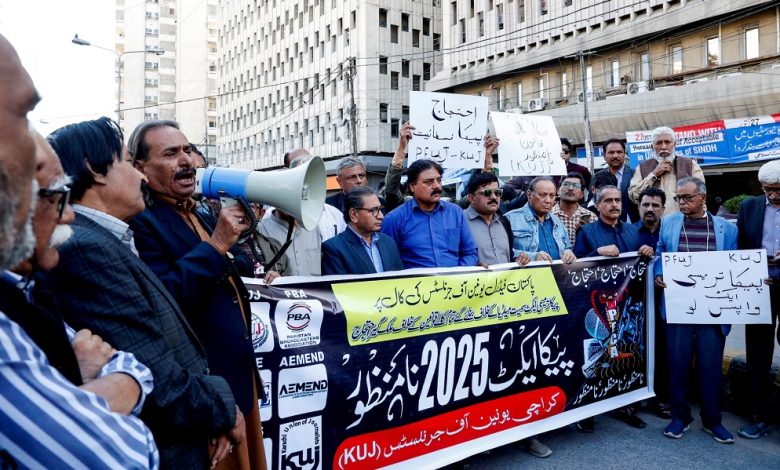
The Committee to Protect Journalists had previously warned that such investigations and prosecutions in Pakistan are retaliatory measures in response to critical media reporting. The organization urged authorities to stop the pressure, intimidation, and censorship of the media.
In addition to life imprisonment, the court imposed supplementary punishments and fines, warning that failure to pay the fines would result in extended prison terms. These rulings require final approval from the Islamabad High Court to be enforced.