Taliban Sees Iran as an Inevitable Neighbor, Not a Strategic Partner
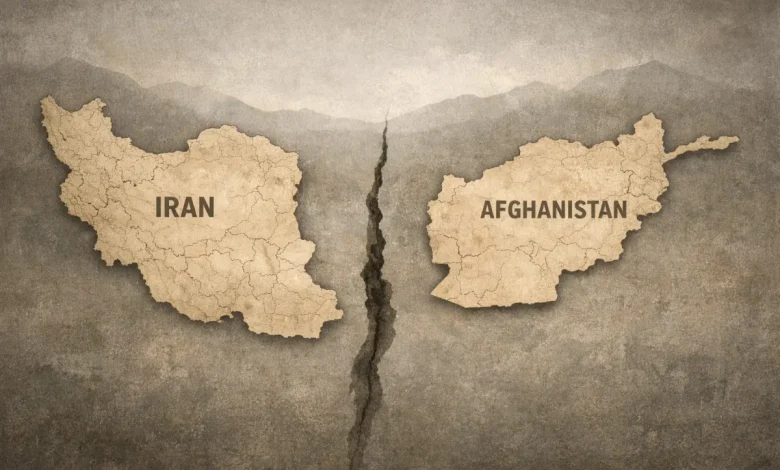
The Taliban’s absence from a regional meeting on Afghanistan hosted by Iran may at first appear to be a logistical decision or a minor disagreement, but in reality it conveys a deeper message about how the group perceives Iran’s role in Afghanistan’s regional politics. This absence is not mere negligence—it is a calculated move: the Taliban does not want Iran to become the main regional channel for Afghan engagement, nor to gain expanded political influence over the Afghan dossier.
Since returning to power, the Taliban has pursued a foreign policy based not on lasting alliances but on fluid, tactical, and controllable relationships. In this context, the group regards Iran as an inevitable neighbor rather than a strategic ally.
From the Taliban’s perspective, allowing Iran to emerge as a central player in regional negotiations over Afghanistan could lead to undesirable consequences. This would mean increasing the influence of a country with a defined and assertive agenda—one that faces stiff regional competition and is under significant international sanctions. The Taliban is fully aware that growing too close to Iran could provoke concerns among other key players such as Pakistan—a principal channel of Taliban’s security and political leverage—along with Arab states and even China, whose economic and investment ties are more valuable to the Taliban.
Moreover, the Taliban seeks to portray an image of political independence. Within the group’s rhetoric, such independence forms an essential part of its domestic and regional legitimacy. Allowing Iran to assume a central role in regional engagement could be interpreted as falling under Tehran’s foreign policy orbit—a notion that contradicts the Taliban’s narrative of sovereign and non-aligned governance. As a result, the group prefers to maintain dispersed and multi-channel regional ties, ensuring that no single country— even a key neighbor like Iran—dominates Afghanistan’s dialogue with the world.
This preference is consistent with the group’s closer alignment with other actors. Pakistan remains a historical and security partner; Qatar provides political and diplomatic mediation; and China offers practical, investment-driven engagement without strong ideological or human rights conditions. Compared with these options, Iran neither guarantees the Taliban’s international legitimacy nor possesses the economic capacity to be a primary benefactor. Instead, its relationship with the Taliban involves numerous expectations and sensitivities that the group prefers to manage minimally.
In this light, the Taliban’s absence from the Tehran summit is a subtle diplomatic “no” to Iran’s efforts to expand its role in Afghanistan. This indicates the Taliban’s intent to retain political agency and prevent others from defining the framework of Afghanistan’s international relations. At the same time, the move does not signify a break or open hostility with Iran; rather, it’s a calculated effort to maintain distance—preserving ties while avoiding strategic deepening.
In the end, Iran-Taliban relations should be understood as existing in a gray zone between cooperation and mistrust. The Taliban needs Iran, but not as a strategic partner. Iran, too, is reliant on Afghan stability and dialogue with its rulers, yet faces considerable constraints. Unless this equation changes, actions like the Taliban’s absence from key Iran-hosted regional meetings are likely to continue—not as signs of crisis, but as reflections of the Taliban’s cold, calculated, and cautious foreign policy.